Wednesday, May 6, 2009
We Want Candy…and 1st Edition and Leeks!
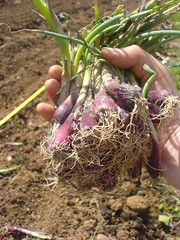
It’s onion planting time at the Local Food Project garden and we’re excited about getting this crop in the ground. We planted Candy, a delicious yellow onion we couldn’t get enough of last year, alongside Red Candy Apple, a new red variety from Dixondale Farms. In another section (five 3x33 foot beds), we’ll plant 1st Edition and Red Torpedo Tropea, then put in a section of leeks. We’re also experimenting with two different planting styles. The first is our regular four-row, one onion every six inches layout. The second has only two rows spaced wider apart and bunches of four onions every foot. The same number of onions go into each 33 foot bed so we’ll see how they do and compare the yields from each.
Monday, May 4, 2009
Lunchtime for Tomato Starts
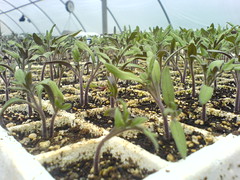
At the end of March the Local Food Project crew started our summer tomato crop in flats. We sowed seeds for our favorite cherry tomato (Sun Gold), a strain of Roma selected especially for Virginia, a volunteer heirloom we saved seeds from last year, plus several purple/black tomatoes to compare which varieties we like best—Black from Tula, Cherokee Purple, Nyagous, and Purple Russian. Now (about four weeks later) we’re transferring the tiny seedlings to larger flats, giving them a fresh dose of nutrients and more space to spread their roots—a tasty lunch after breakfast in the smaller flats. Soon they’ll help themselves to dinner in the soil of our garden.
Thursday, April 30, 2009
Planting Potatoes for Earth Day
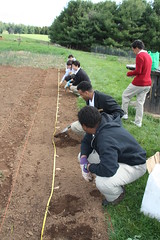
The Local Food Project celebrated Earth Day by inviting Airlie Center staff to come visit the garden, enjoy the sultry warmth of the hoophouse, and join us for potato planting. Inside the hoophouse, we talked about the fast-growing Arugula we’re harvesting from the north bed and the soon to be transplanted Sun Gold cherry tomatoes that will thrive in the coming heat. Out in the field, a crew of energetic volunteers from Airlie’s housekeeping department planted an entire section (five 33-foot beds) of Russian Banana fingerling potatoes in only 20 minutes! We really enjoyed visiting with all of our Airlie colleagues and look forward to welcoming them back when the garden is in full bloom.
Tuesday, April 28, 2009
H.O.E.—Hands-on Organic Education
Last week, the Local Food Project crew led a fun team building workshop from our new menu of garden activities for groups staying at Airlie. In addition to tours, the LFP now offers interactive gardening projects we fondly call “H.O.E”—Hands-on Organic Education. Guests not only learn about the project and its role at Airlie and in the community, they also have the chance to experience the garden up close, try out our favorite handtools, and collaborate with their co-workers.
Our first H.O.E. activity was a great success with the two teams—who named themselves “The Double Diggers” (after our Parking Space plot) and “The Earthworms”—quickly getting into the rhythm of using broadforks to loosen the soil. They worked together to weed, spread compost, and rake the beds smooth, then planted Mei Qing pac choi in 12-inch triangles. For the finishing touch, they protected their neatly planted beds with fabric row cover draped over wire hoops. The new gardeners were rewarded with the knowledge that the crops they planted would eventually take their place on the Airlie Center buffet, feeding future guests like themselves. And after an afternoon of hard work, they relaxed in the garden with locally-sourced treats. We’re looking forward to our next opportunity to break out the H.O.E.!
Wednesday, April 8, 2009
Digging in to Small Farm Design
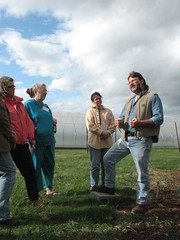
Participants at last weekend’s “Skills, Scale, Sustainability” workshop took home a whole new toolbox full of ideas and strategies for designing, managing, and enhancing a small-scale food-growing system. Facilitator Shane J. LaBrake drew on a lifetime’s worth of farming experience to inspire course attendees to put their sustainable agriculture dreams into motion.
During the 2.5-day workshop, Shane returned again and again to one of his favorite quotes from William McDonough—“Design is the first signal of human intention.” He showed participants how to apply that concept philosophically—in the way they set up and think about the integration of their farm system—and practically—as they lay out the beds and set the schedule for a vegetable garden. Shane’s approach to tractor operation and maintenance emphasized two simple policies: 1. Read the manual. 2. Safety, safety, safety. Attendees were empowered to understand how tractors work and feel comfortable operating them on their own farms. The workshop was a real success thanks to Shane’s depth of knowledge and the enthusiasm of the participants. View more photos from the weekend.
Tuesday, March 24, 2009
Starting Broccoli and Cabbage
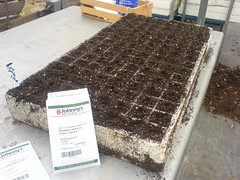
The Local Food Project crew spent an afternoon starting seeds for our first spring field crops—cool weather-loving broccoli (Gypsy and De Cicco) and cabbage (Gonzales). After filling flats with dark, fluffy potting mix, we poked shallow holes in the center of all 128 cells. We dropped in the tiny round seeds by ones and twos, then carefully tucked them, covering them with a light layer of potting mix. After a gentle watering, we set the flats atop heating mats, which will give the seeds an extra boost of warmth as they work to put out roots and sprout. We’ll be starting more seeds in the days and weeks to come and transplanting day will be here before we know it!
Monday, March 16, 2009
Some New Varieties for 2009
We placed the last of our seed orders for the summer season and the Local Food Project crew is looking forward to harvesting some old favorites like Ermosa lettuce, Sun Gold cherry tomatoes, and Sweet Chocolate peppers. We’re also excited to try out some new varieties this year—red and purple speckled Scarlet Runner bean, bumpy blue Marina di Chioggia pumpkin, blackish purple Nyagous tomato, and other unique vegetables, flowers, and herbs we can’t wait to try and share!
Subscribe to:
Posts (Atom)


