Lettuce loves the fall, in and around DC. Cool, moderate conditions are perfect for the tender leaves of lettuce, which acquire a sweet crispiness in October.
Lettuce can tolerate frosty weather, but it needs a little protection. That’s because those tender leaves can take a hit if they freeze and are exposed to a punishing wind.
At the DC Green Fest a week ago, we launched a lettuce revolution, giving out 1,500 baby lettuce plants to 1,500 Green Fest visitors who signed-up for our Local Food Project newsletter- the Broad Fork Express (named for our favorite garden tool). But with a lettuce head in hand, now what?
How to grow lettuce in and around Washington D.C. (in October).
At the Local Food Project at Airlie, we have a simple acronym that identifies four areas an organic gardener must address to achieve success with a crop. This acronym is SNAP! (Seed, Nourish, Advance, Protect).
Seed- without seed, you don’t have a garden. Even a vegetable garden dependent on transplants from the nursery is one ultimately dependent on seed! The first thing an organic gardener needs to know is that not all seeds are the same. Lettuce is not lettuce is not lettuce. There are hundreds of varieties out there in a range of garden catalogues. Some are hybrids, some are heirlooms (save that discussion for later…better yet ‘google’ ‘heirloom seed’ and read), and have been bred over generations for a range of needs and conditions. For instance, some lettuce varieties thrive in colder weather, and make it much further into the winter- they have been selected and developed for this property. All the lettuce seeds we started in the greenhouse to give out at the Green Fest and to plant in our passive solar hoophouse are varieties bred for the winter. They are heirloom varieties we purchased from
Southern Exposure Seeds.
*Capitan
*Yugoslavian Red Butterhead
*Rouge D’Hiver (“Red Winter”)
*Forellenschluss (“Speckled Trout”)
*Deer Tongue
These five lettuce varieties all do well in the cold, have excellent flavor, have been tried and tested and passed down through generations, and will be planted all over the DC metro area after the DC Green Fest this weekend. If the Green Festival were in early summer, the Local Food Project would focus on lettuce varieties that can withstand heat (Sweet Valentine, Jericho, etc.). But the days of October grow colder, and we need lettuce plants that are up for a winter challenge.
You won’t feed a family with one lettuce plant, but we hope that one single lettuce plant, put into the garden, or window box, will become the catalyst for food-producing-transformation in many of those folks who adopted the plant and Nourished that little lettuce into a whopping Thanksgiving treat.
Before we move on to Nourish, two more points about seed. First, seed varies in quality, so get it from a reputable source. Second, “seed”, in common organic gardener and farmer vernacular, is also a verb, and is synonomous with “sow”. Instead of “Sow that bed with some lettuce seed,” the efficient farmer will often state to her crew, “Seed that bed!” And the tool often used to sow seed is a “seeder”.
We lead off our acronym with Seed because, above all else, you need seed to have a veggie garden, but you also need to seed the seed. Sometimes we gardeners over think our gardens, get out a hundred books, and never get to the actual seeding and planting. Stick seeds in containers, stick ‘em in the ground, but don’t leave them to wither in packets!
Conclusion- Seed good seed with a seeder.
So Nourish, the second word encoded in our clever acronym SNAP! Nourishment for vegetables comes in many forms. For organic gardeners, we should create another sub-acronym for Nourishment, but the problem is that there are so many forms of nourishment it would be hard to come up with the right acronym, unless the acronym was N.o.u.r.i.s.h.m.e.n.t, but that would be working backwards, and trying too hard.
Nourishment for most vegetables includes:
Sunlight, and lots of it. Lettuce really likes the sun. Problem is, when we have lots of sun around here, it’s often too hot for lettuce. That’s why spring and fall are so important to the lettuce family in and around DC. Enough sun, but not too hot.
Water, in even moderation. Lettuce loves water, but like most vegetables, not too much. Many organic gardeners, conscientious beings they are, water too much, and drown their plants. It’s better to water thoroughly 2-3 times a week than every day. In the fall and spring, water less. That’s because the water table tends to be much higher, and soils stay moist much longer in the cooler temps.
Healthy Soil- so you’ve got sunlight and water, but if you’re growing organically, you need a nice, healthy soil. Healthy soil has plenty of well-decomposed organic matter, like compost and decayed root systems and plant matter, that feeds microbes which in turn feed growing plants. Healthy soil is well-draining and well-aerated. The organic matter helps with this, as do the worms creating channels through the soil as they digest organic matter. Plants need air in the soil for expanding root systems and optimal microbial populations to enhance plant growth. Healthy soil also has a good balance of rock minerals & slow-release nutrients that work in concert with organic matter and microbes to provide plants the full-spectrum of food they need to grow with speed. A soil-test can help reveal which minerals may be missing in your garden soil. A final component of a healthy garden soil, many organic gardeners would argue, is a mulch over the surface of the soil that boosts microbial activity near the surface of the soil, feeds worms over time, and keeps soil evenly moist during dry-spells, among other things. Straw, leaves & other plant matter are popular organic garden mulch materials.
Nourishment can also include optimizing the soil & air temperatures that vegetables want to grow best.
Floating row cover and other materials can add warmth to plants in the beginning and late stages of the season to speed their growth. Most lettuces in the DC area are going to want a little supplemental warmth, in the form of a protective cover, in late October and Fall, so this is where “Nourish” might overlap with “Protect”, but first let’s consider the ‘A’ in SNAP- Advance.
*A final note about Nourish- the best fertilizer, as the old saying goes, is the footprint of the farmer. That means that the attentive care of the farmer and gardener goes a long way in seeing crops through to a bountiful harvest.
Advance – Organic farming and gardening can be a real challenge. All kinds of pests want to eat your crop, and one lettuce plant out there in the garden on its own is no exception! We need that lettuce to grow fast. There are many ways we can help plants grow fast. We can start them out in the sheltered environment of the greenhouse, so the seed germinates quickly and does not have to fend off neighboring weeds that want to grab all access to sunlight. We can supplement the garden with more water during hot spells, or dry spells. We can cultivate around our lettuces and vegetable plants to stimulate the soil and remove weed competition (overlapping with ‘Protect’). As our plants grow, we can add a little organic booster, like fish emulsion or compost tea, or a top-dressing of compost right around the plants on the surface of the soil. These are all things we organic gardeners can do to ‘Advance’ our plants and help them grow as quickly as possible. Plants that are stalled out because they are in overcrowded conditions, or poor soils, or unsheltered from weather extremes, are plants in trouble. ‘Advance’ is all about the little things we gardeners can do to make the difference, the proverbial ‘Green Thumb’. The trick is not to overdo it. A little bit here and there can go a long way.
Protect- The final component of our LFP garden acronym, but should probably be the first! That’s because ‘Protect’ is arguably the weakest component of many an organic garden. Here’s why- we get excited about ordering seeds, working up the soil and planting, we get excited about the harvest, and in all this excitement we forget about the importance of protecting the crop. Only when the deer have razed our plants to the ground, or the squash bugs overtake our zucchini, or a frost kills all our hardwork, do we think “Gee I should have done a little something to protect the harvest!” “Protect” is about working backwards, imagining the things that will inevitably happen if crops are unprotected, and working to prevent the damage from being done. Working backwards kills the spontaneity of the organic garden, or so it seems, but ultimately creates much more satisfaction. First, protect your garden from large critters like deer and groundhogs and rabbits by building a good garden fence. The ideal fence is tall enough to keep deer out, and reinforced at the bottom to prevent gnawing. Any fence at all would be a good start if you don’t currently have one. Second, protect your crops from bugs by monitoring them closely. So many infestations can be prevented just by recognizing the warning signs. Row-cover and fabrics can be employed to keep bugs off certain types of vegetable plants until they are large enough to withstand some pest pressure. Non-toxic biological controls can be employed in select circumstances where all other approaches fail. Promoting habitat for beneficial insects in the garden is a form of ‘Protect’. Third, protect your crops from frost and weather extremes. Blankets and row cover can protect your crops when it first starts to get really cold outside. Another strategy involves patience, and planting your plants at the right time of the season! Many gardeners plant their tomatoes too early, only to be nipped by a frost, or to languish in cool weather.
SNAP- Seed, Nourish, Advance & Protect is a basic way to understand the areas of concern for the organic gardener.
Regarding your singular heirloom lettuce plant-
Seed- stick the thing in the ground, and fast. Work up the soil around the plant, and try to keep the leaves above ground level, and the roots below ground level, just like planting a mini-tree. Water in gently.
Nourish- hopefully you have planted that lettuce into a nice rich organic soil. If not, sprinkle some compost in a six inch wide circle around the plant, and incorporate lightly into the soil. Create a little greenhouse (with breathing and air flow) for the plant at night as it gets colder. Cut off the bottom of a plastic milk jug, and remove the cap- a perfect greenhouse that can release heat. But don’t leave it on all day, because your lettuce plant wants as much sunlight as possible. Drape some fabric over the mini-greenhouse on a really cold night.
Advance- Lettuce does not need much additional help, aside from a little water now and again, and a bit of protection and warmth when it gets colder outside. The crops that really need advancement in an organic system are fruiting crops. Squash, for instance, benefit enormously from a handful of compost packed around the base of the stem right as the plant begins to set fruit
Protect- Bunnies and deer and groundhogs want to eat your little lettuce, way more than you do. Think about fencing up front!


 Yugoslavian Red Butterhead
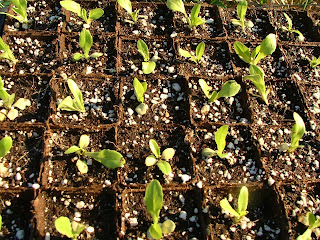 Deer Tongue
 Forellenschluss
 Capitan
  Rouge D'Hiver


