Showing posts with label vegetables. Show all posts

Tuesday, September 21, 2010

Fresh Vegetables Five Stories Up

These lucky vegetables have quite a view. Only a block away from the hustle and bustle of M Street, the crops planted on the rooftop of this five-story building in Georgetown overlook all of Washington. They also have produced pounds of delicious eggplant, cherry tomatoes, basil, and parsley in a typically undervalued and underutilized urban space.

Most people who stroll by on the sidewalk below or eat lunch on the restaurant patios at ground level would never guess that the roof of this building provides fresh food to the people who live and work inside it. For the past several seasons, the Local Food Project has demonstrated the potential to grow food in small spaces with our 9 by 14-foot Parking Space Garden. Now we are exploring other ways to garden in space-constrained environments. LFP’s new initiative this season—the Georgetown Rooftop Food Project—answers the call to make local food even more local by growing it right in the city.

Standing among the raised beds of  the Georgetown Rooftop Food Project (or GRFP for short), its urban location is impossible to forget. Airplanes roar overhead as they take off and land at Reagan National Airport. The Washington Monument and Air Force Memorial jut up from the city’s signature low skyline. Children laugh and yell in the yard of a neighboring preschool and rooftop exhaust fans rattle constantly. But there’s also a special peace that comes with the high-altitude breeze and gives this garden an air of possibility. If vegetables and herbs can be grown on this roof, why not others? And if people enjoy the flavor and freshness of this produce, what does that signify for their relationships to other kinds of food? And how can projects like this one encourage more urban residents to eat locally produced food and even grow some of their own?

As summer draws to a close and fall winds blow in, we’ll continue to harvest the bounty at GRFP. We’ll also be thinking about what might come next for this elevated garden in the city. If you have ideas or want to check it out, let us know!

Monday, June 14, 2010

June Update

Hello faithful readers! Ben here. It's hard to believe we're already half way through June--the month is passing by like an afternoon shower!


The past month has been full of activity here at the Local Food Project. So full, in fact, that we haven't kept up with this blog as much as we would like. Since so much has happened, let's lean on this writer's favorite crutch: bullet points. Here's a smattering of what we've been up to at the LFP.

  • We attended another great CRAFT program event at The Farm at Sunnyside. A great turnout and a lot of great food! See this post for more about the CRAFT program.
  • Pablo contributed an article to Flavor Magazine, describing the CRAFT program its value to aspiring farmers.
  • We planted 30 beds (2700 sq ft) of squash, cucumbers, zucchini, lettuce mix, and beets...in one day!

  • Filled the hoop house with tomatoes, peppers, and eggplant.
  • Completed various infrastructure projects such as reinforcing our deer fence and cutting new row cover.
  • Humanely trapped a family of groundhogs whose home was not even ten feet from our squash beds. We dropped them off far away from the garden. I believe a groundhog is born with the right to look for his shadow, as long as that shadow is not cast on our crops.
  • Hosted several tours and a team building dinner with guests at the Airlie Center.
  • Last, but certainly not least, we acquired two interns to (do all of the) work for us during the next 6-8 weeks. Welcome Shaina and Yuka!

Now you're up to speed. We have another CRAFT event this week and plants growing quickly, so we'll have more to report soon.

Monday, March 22, 2010

Spring Garlic Greens


March is the fastest month of the year here at the LFP garden! Not in terms of harvest, or even physical activity, but the rate of change. To recap: the month started with piles of snow and broken tree limbs everyhwere, as the DC area slowly recovered from the mess of 'snowmaggedon', 'snowcalypse', and whatever over-the-top phrase used to describe the over-the-top winter storms we endured here in early 2010.

And just a few weeks later, the frogs are out hopping, trees are budding rapidly, the grass is green, and farmers already feel behind!

The sound of geese heading North at pre-dawn makes for restless starts to mornings. We farmers and gardeners twist and turn with all the things we still need to get done in the mythical 'off-season', that seeming infinite expanse of winter to do all possible manner of projects, which instead got stuffed with holidays, snow, and sleep.

How is it that three weeks can take us from a blanketed winterland to the humid, dark green rush of flora and fauna energy?

Add to this surge in biological activity a surge in the length of our daytime, thanks to Daylight Savings. Days seem suddenly hours longer, like we've been propelled into a new world where we have an extra half day with which to start seeds, clear old stalks from the garden and repair fence lines.

March brings a frantic close to winter, and a rapid start to spring. It's all evident in the Garlic, which takes the early lead as it shoots through the winter straw mulch.

Tuesday, December 22, 2009

Airlie in the Snow

A couple weeks ago we were excited to harvest Arugula from beneath a light canopy of snow...well now we have two feet of snow in the garden! so not much harvesting happening. We're relieved that the hoophouse shed the snow, and look forward to uncovering the arugula in the garden if this snow ever melts! Looks like it will be around for a long time, so we'll just hang out in the hoophouse until then...


Monday, December 7, 2009

Arugula, Class, Snow & Winter

Four inches of snow sits atop beds of arugula in the Local Food Project garden- meanwhile, winter sowing of arugula and greens carries on in the LFP Passive Solar Hoophouse. As we wrap up a year full of workshops and seminars at Airlie Center, we look forward to our January 2010 Conference- Nordell & Martens: Culture in Cultivation, featuring a small vegetable farm powered by draft horses, and a 1,300 acre organic grain operation with custom milling of animal feeds.


Winter, where the harvest is soooo sweet, literally! That's because the cool temps concentrate sugars in cool weather crops, from carrots to kale to yes, arugula. If you have ever wondered why your garden carrots are not that sweet, is may be partially due to the temps of the soil during harvest. So many crops that are bland or even bitter during the summer and early fall take on an entirely new flavor in the fall and early winter.


The key becomes how you keep these crops alive in the garden for that sweet harvest.

At the LFP garden, we believe in simplicity. Metal hoops (you can cut your own using any decently thick steel wire) straddle our three ft. wide garden beds. Over these hoops, we drape floating row cover, a poly-fabric that provides a mild amount of frost protection (a few degrees), but creates a temperate, wind-free environment in which cold-tolerant greens and roots (like radishes, carrots & beets) can hang around and sweeten up until harvest. The row cover comes in varying thicknesses and price, but we like to use the stuff that is in the middle- not too light, not too heavy.


So when it snows, the cover will at least provide a little buffer between the plants and the snow, provided the snow is not too heavy. It is truly amazing to dust off the snow, and uncover a dazzling green bed of crispy greens amidst a winter wonderland!


For heading deep into winter, a hoophouse is the way to go. It's the same concept of providing a little protection for the crops with hoops and a covering, but the hoops are much larger and the covering is a high-grade plastic. In the LFP garden, we have a 30x72 ft. gothic frame hoophouse. The frame came from Ledgewood Farms. The plastic, vents, and end-wall paneling came from Griffins Greenhouse Supply. We harvested and milled all the white oak baseboards and door framing ourselves, with the guidance of experienced timber framer Eric Westergart.


And that brings us back to winter. I encourage all gardeners to go for a winter harvest, which is essentially an extension of your fall crops via a little protection from the elements.

Monday, October 19, 2009

Lettuce Revolution

Lettuce loves the fall, in and around DC. Cool, moderate conditions are perfect for the tender leaves of lettuce, which acquire a sweet crispiness in October.

Lettuce can tolerate frosty weather, but it needs a little protection. That’s because those tender leaves can take a hit if they freeze and are exposed to a punishing wind.

At the DC Green Fest a week ago, we launched a lettuce revolution, giving out 1,500 baby lettuce plants to 1,500 Green Fest visitors who signed-up for our Local Food Project newsletter- the Broad Fork Express (named for our favorite garden tool). But with a lettuce head in hand, now what?

How to grow lettuce in and around Washington D.C. (in October).

At the Local Food Project at Airlie, we have a simple acronym that identifies four areas an organic gardener must address to achieve success with a crop. This acronym is SNAP! (Seed, Nourish, Advance, Protect).

Seed- without seed, you don’t have a garden. Even a vegetable garden dependent on transplants from the nursery is one ultimately dependent on seed! The first thing an organic gardener needs to know is that not all seeds are the same. Lettuce is not lettuce is not lettuce. There are hundreds of varieties out there in a range of garden catalogues. Some are hybrids, some are heirlooms (save that discussion for later…better yet ‘google’ ‘heirloom seed’ and read), and have been bred over generations for a range of needs and conditions. For instance, some lettuce varieties thrive in colder weather, and make it much further into the winter- they have been selected and developed for this property. All the lettuce seeds we started in the greenhouse to give out at the Green Fest and to plant in our passive solar hoophouse are varieties bred for the winter. They are heirloom varieties we purchased from Southern Exposure Seeds.

*Capitan

*Yugoslavian Red Butterhead

*Rouge D’Hiver (“Red Winter”)

*Forellenschluss (“Speckled Trout”)

*Deer Tongue


These five lettuce varieties all do well in the cold, have excellent flavor, have been tried and tested and passed down through generations, and will be planted all over the DC metro area after the DC Green Fest this weekend. If the Green Festival were in early summer, the Local Food Project would focus on lettuce varieties that can withstand heat (Sweet Valentine, Jericho, etc.). But the days of October grow colder, and we need lettuce plants that are up for a winter challenge.

You won’t feed a family with one lettuce plant, but we hope that one single lettuce plant, put into the garden, or window box, will become the catalyst for food-producing-transformation in many of those folks who adopted the plant and Nourished that little lettuce into a whopping Thanksgiving treat.

Before we move on to Nourish, two more points about seed. First, seed varies in quality, so get it from a reputable source. Second, “seed”, in common organic gardener and farmer vernacular, is also a verb, and is synonomous with “sow”. Instead of “Sow that bed with some lettuce seed,” the efficient farmer will often state to her crew, “Seed that bed!” And the tool often used to sow seed is a “seeder”.

We lead off our acronym with Seed because, above all else, you need seed to have a veggie garden, but you also need to seed the seed. Sometimes we gardeners over think our gardens, get out a hundred books, and never get to the actual seeding and planting. Stick seeds in containers, stick ‘em in the ground, but don’t leave them to wither in packets!

Conclusion- Seed good seed with a seeder.

So Nourish, the second word encoded in our clever acronym SNAP! Nourishment for vegetables comes in many forms. For organic gardeners, we should create another sub-acronym for Nourishment, but the problem is that there are so many forms of nourishment it would be hard to come up with the right acronym, unless the acronym was N.o.u.r.i.s.h.m.e.n.t, but that would be working backwards, and trying too hard.

Nourishment for most vegetables includes:

Sunlight, and lots of it. Lettuce really likes the sun. Problem is, when we have lots of sun around here, it’s often too hot for lettuce. That’s why spring and fall are so important to the lettuce family in and around DC. Enough sun, but not too hot.

Water, in even moderation. Lettuce loves water, but like most vegetables, not too much. Many organic gardeners, conscientious beings they are, water too much, and drown their plants. It’s better to water thoroughly 2-3 times a week than every day. In the fall and spring, water less. That’s because the water table tends to be much higher, and soils stay moist much longer in the cooler temps.

Healthy Soil- so you’ve got sunlight and water, but if you’re growing organically, you need a nice, healthy soil. Healthy soil has plenty of well-decomposed organic matter, like compost and decayed root systems and plant matter, that feeds microbes which in turn feed growing plants. Healthy soil is well-draining and well-aerated. The organic matter helps with this, as do the worms creating channels through the soil as they digest organic matter. Plants need air in the soil for expanding root systems and optimal microbial populations to enhance plant growth. Healthy soil also has a good balance of rock minerals & slow-release nutrients that work in concert with organic matter and microbes to provide plants the full-spectrum of food they need to grow with speed. A soil-test can help reveal which minerals may be missing in your garden soil. A final component of a healthy garden soil, many organic gardeners would argue, is a mulch over the surface of the soil that boosts microbial activity near the surface of the soil, feeds worms over time, and keeps soil evenly moist during dry-spells, among other things. Straw, leaves & other plant matter are popular organic garden mulch materials.

Nourishment can also include optimizing the soil & air temperatures that vegetables want to grow best. Floating row cover and other materials can add warmth to plants in the beginning and late stages of the season to speed their growth. Most lettuces in the DC area are going to want a little supplemental warmth, in the form of a protective cover, in late October and Fall, so this is where “Nourish” might overlap with “Protect”, but first let’s consider the ‘A’ in SNAP- Advance.

*A final note about Nourish- the best fertilizer, as the old saying goes, is the footprint of the farmer. That means that the attentive care of the farmer and gardener goes a long way in seeing crops through to a bountiful harvest.


Advance – Organic farming and gardening can be a real challenge. All kinds of pests want to eat your crop, and one lettuce plant out there in the garden on its own is no exception! We need that lettuce to grow fast. There are many ways we can help plants grow fast. We can start them out in the sheltered environment of the greenhouse, so the seed germinates quickly and does not have to fend off neighboring weeds that want to grab all access to sunlight. We can supplement the garden with more water during hot spells, or dry spells. We can cultivate around our lettuces and vegetable plants to stimulate the soil and remove weed competition (overlapping with ‘Protect’). As our plants grow, we can add a little organic booster, like fish emulsion or compost tea, or a top-dressing of compost right around the plants on the surface of the soil. These are all things we organic gardeners can do to ‘Advance’ our plants and help them grow as quickly as possible. Plants that are stalled out because they are in overcrowded conditions, or poor soils, or unsheltered from weather extremes, are plants in trouble. ‘Advance’ is all about the little things we gardeners can do to make the difference, the proverbial ‘Green Thumb’. The trick is not to overdo it. A little bit here and there can go a long way.

Protect- The final component of our LFP garden acronym, but should probably be the first! That’s because ‘Protect’ is arguably the weakest component of many an organic garden. Here’s why- we get excited about ordering seeds, working up the soil and planting, we get excited about the harvest, and in all this excitement we forget about the importance of protecting the crop. Only when the deer have razed our plants to the ground, or the squash bugs overtake our zucchini, or a frost kills all our hardwork, do we think “Gee I should have done a little something to protect the harvest!” “Protect” is about working backwards, imagining the things that will inevitably happen if crops are unprotected, and working to prevent the damage from being done. Working backwards kills the spontaneity of the organic garden, or so it seems, but ultimately creates much more satisfaction. First, protect your garden from large critters like deer and groundhogs and rabbits by building a good garden fence. The ideal fence is tall enough to keep deer out, and reinforced at the bottom to prevent gnawing. Any fence at all would be a good start if you don’t currently have one. Second, protect your crops from bugs by monitoring them closely. So many infestations can be prevented just by recognizing the warning signs. Row-cover and fabrics can be employed to keep bugs off certain types of vegetable plants until they are large enough to withstand some pest pressure. Non-toxic biological controls can be employed in select circumstances where all other approaches fail. Promoting habitat for beneficial insects in the garden is a form of ‘Protect’. Third, protect your crops from frost and weather extremes. Blankets and row cover can protect your crops when it first starts to get really cold outside. Another strategy involves patience, and planting your plants at the right time of the season! Many gardeners plant their tomatoes too early, only to be nipped by a frost, or to languish in cool weather.

SNAP- Seed, Nourish, Advance & Protect is a basic way to understand the areas of concern for the organic gardener.

Regarding your singular heirloom lettuce plant-

Seed- stick the thing in the ground, and fast. Work up the soil around the plant, and try to keep the leaves above ground level, and the roots below ground level, just like planting a mini-tree. Water in gently.

Nourish- hopefully you have planted that lettuce into a nice rich organic soil. If not, sprinkle some compost in a six inch wide circle around the plant, and incorporate lightly into the soil. Create a little greenhouse (with breathing and air flow) for the plant at night as it gets colder. Cut off the bottom of a plastic milk jug, and remove the cap- a perfect greenhouse that can release heat. But don’t leave it on all day, because your lettuce plant wants as much sunlight as possible. Drape some fabric over the mini-greenhouse on a really cold night.

Advance- Lettuce does not need much additional help, aside from a little water now and again, and a bit of protection and warmth when it gets colder outside. The crops that really need advancement in an organic system are fruiting crops. Squash, for instance, benefit enormously from a handful of compost packed around the base of the stem right as the plant begins to set fruit

Protect- Bunnies and deer and groundhogs want to eat your little lettuce, way more than you do. Think about fencing up front!

Thursday, October 8, 2009

What Kind of Lettuce Will You Plant?

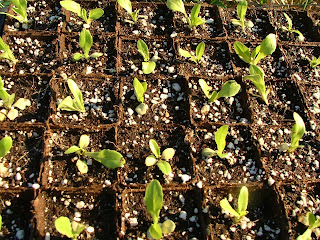
Did you stop by the Local Food Project booth at the Green Festival October 10 and 11 and pick up a free lettuce seedling? Then check out the pictures below to figure out what variety you have.

Yugoslavian Red Butterhead

Deer Tongue

Forellenschluss

Capitan
Rouge D'Hiver

Thursday, June 25, 2009

Lots of Lettuce

The Local Food Project crew is harvesting baskets and baskets of crisp, crunchy lettuce these days. Pink-tinged Fireball, frilly green Nevada, and tall ruffled Concept all appreciate the wet, mild weather. We planted the little seedlings close together (six inches apart in four rows) and began harvesting them out as baby lettuce heads. Now they’re all growing fast and we’re supplying bountiful lettuce for lots of fresh salads for Airlie guests.

Wednesday, June 3, 2009

Tomatoes, Start Your Engines!

As temperatures begin to climb, the Local Food Project hoophouse is becoming a hot, humid environment—perfect for tomatoes eager to get out of their flats and into the ground. Last week the LFP crew planted three hoophouse sections (about 100 square feet each) of different kinds of tomatoes. We gave our favorite from last year—Sun Gold—center stage in the wide bed right inside the main door. Other varieties we’re looking forward to harvesting include Pineapple, Brandywine, Geronimo, Glacier, and Cobra. With basil interplanted between the tomatoes, the hoophouse truly has the aroma of summer!

Wednesday, May 6, 2009

We Want Candy…and 1st Edition and Leeks!

It’s onion planting time at the Local Food Project garden and we’re excited about getting this crop in the ground. We planted Candy, a delicious yellow onion we couldn’t get enough of last year, alongside Red Candy Apple, a new red variety from Dixondale Farms. In another section (five 3x33 foot beds), we’ll plant 1st Edition and Red Torpedo Tropea, then put in a section of leeks. We’re also experimenting with two different planting styles. The first is our regular four-row, one onion every six inches layout. The second has only two rows spaced wider apart and bunches of four onions every foot. The same number of onions go into each 33 foot bed so we’ll see how they do and compare the yields from each.

Monday, May 4, 2009

Lunchtime for Tomato Starts

At the end of March the Local Food Project crew started our summer tomato crop in flats. We sowed seeds for our favorite cherry tomato (Sun Gold), a strain of Roma selected especially for Virginia, a volunteer heirloom we saved seeds from last year, plus several purple/black tomatoes to compare which varieties we like best—Black from Tula, Cherokee Purple, Nyagous, and Purple Russian. Now (about four weeks later) we’re transferring the tiny seedlings to larger flats, giving them a fresh dose of nutrients and more space to spread their roots—a tasty lunch after breakfast in the smaller flats. Soon they’ll help themselves to dinner in the soil of our garden.

Thursday, April 30, 2009

Planting Potatoes for Earth Day

The Local Food Project celebrated Earth Day by inviting Airlie Center staff to come visit the garden, enjoy the sultry warmth of the hoophouse, and join us for potato planting. Inside the hoophouse, we talked about the fast-growing Arugula we’re harvesting from the north bed and the soon to be transplanted Sun Gold cherry tomatoes that will thrive in the coming heat. Out in the field, a crew of energetic volunteers from Airlie’s housekeeping department planted an entire section (five 33-foot beds) of Russian Banana fingerling potatoes in only 20 minutes! We really enjoyed visiting with all of our Airlie colleagues and look forward to welcoming them back when the garden is in full bloom.

Tuesday, March 24, 2009

Starting Broccoli and Cabbage

The Local Food Project crew spent an afternoon starting seeds for our first spring field crops—cool weather-loving broccoli (Gypsy and De Cicco) and cabbage (Gonzales). After filling flats with dark, fluffy potting mix, we poked shallow holes in the center of all 128 cells. We dropped in the tiny round seeds by ones and twos, then carefully tucked them, covering them with a light layer of potting mix. After a gentle watering, we set the flats atop heating mats, which will give the seeds an extra boost of warmth as they work to put out roots and sprout. We’ll be starting more seeds in the days and weeks to come and transplanting day will be here before we know it!

Thursday, December 11, 2008

Winter’s Many Shades of Green

Our new batch of seeds for the hoophouse recently arrived and we can already envision the tasty salads we’ll be harvesting for Airlie Center’s guests come February.

Arugula—Astro
Asian Greens—Yukina Savoy and Tatsoi
Cress—Presto
Pac Choi—Mei Qing
Allstar Lettuce Mix
Encore Lettuce Mix
Minutina (Erba Stella)

Monday, December 8, 2008

December’s Colorful Harvest

The first day of December dawned cold and gray, but these brilliantly-colored beets made the garden feel as festive as the tropics! Surviving the frosts under swaths of row cover, our “Chioggia” (red) and “Golden” (orange) beets are a favorite of Airlie Center chefs and are among the last of our 2008 field crops.

Another heartening find was this perfect head of “Red Cross” lettuce, still prettily ruffled, crisp, and unharmed by frost, deer, or groundhog.

Monday, November 3, 2008

Winter salad bar

This fall marks the Local Food Project’s first season growing veggies in our new passive solar hoophouse. The structure was built with assistance from members of the community during a workshop led by biodynamic farming guru Steve Moore. We laid out the beds and aisles to allow easy access for visitors, setting aside a gathering space in the middle for wine tastings or warming up with hot cocoa. We’re still putting the finishing touches on the hoophouse—installing solar-powered vents, constructing doors from sustainably logged wood—but the cool-season crops we’ve planted are already making great progress.

Here’s what we’re growing:

Green Lettuce—Jericho
Red lettuce—Red Cross, Yugoslavian, and Sweet Valentine
Kale—Laci Nato, Vates
Bok Choy—Mei Ping
Swiss Chard—Rainbow
Basil—Lettuce Leaf, Lemon, Red Rubin, Italian Large Leaf
Dill
Fennel

Once we get the hoophouse completely sealed up, I’m thinking it’s going to be our favorite place to escape the winter cold. And I can’t wait for next spring when it will help launch our spring and summer garden.